
Pass the Mail Carrier exam the first time.
Fail and you may have to wait a year to retest. Practice the same kinds of questions in timed tests, apply on the official postal hiring site the right way, and know what to expect next.
Check My Eligibility →Takes about 30 seconds · Based on published postal hiring requirements
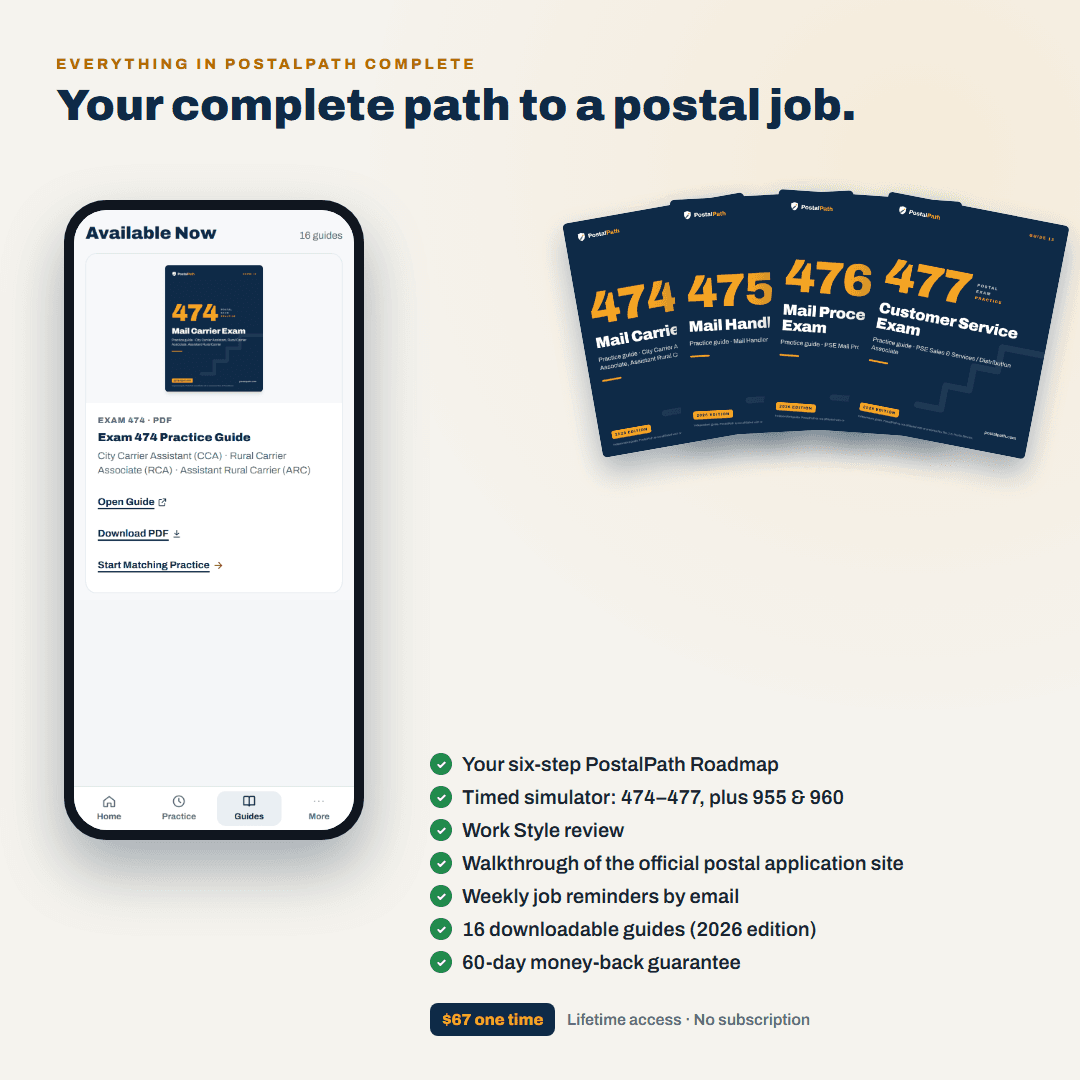
See what’s inside PostalPath Complete
Take a 90-second narrated tour of the tools you get after joining.
Check My Eligibility →Mail Carrier Exam: Deliver mail on foot or by vehicle, in town or on rural routes.
- City Carrier Assistant (CCA) · starting $21.21/hr
- Rural Carrier Associate (RCA) · starting $21.89/hr
- Assistant Rural Carrier (ARC) · starting $21.89/hr
Starting hourly pay from official postings (reviewed October 20, 2026); set by union contracts and the same nationwide. Check your posting for the current rate.
See the job before you apply
The official application asks every applicant to confirm they’ve watched the job video before applying.


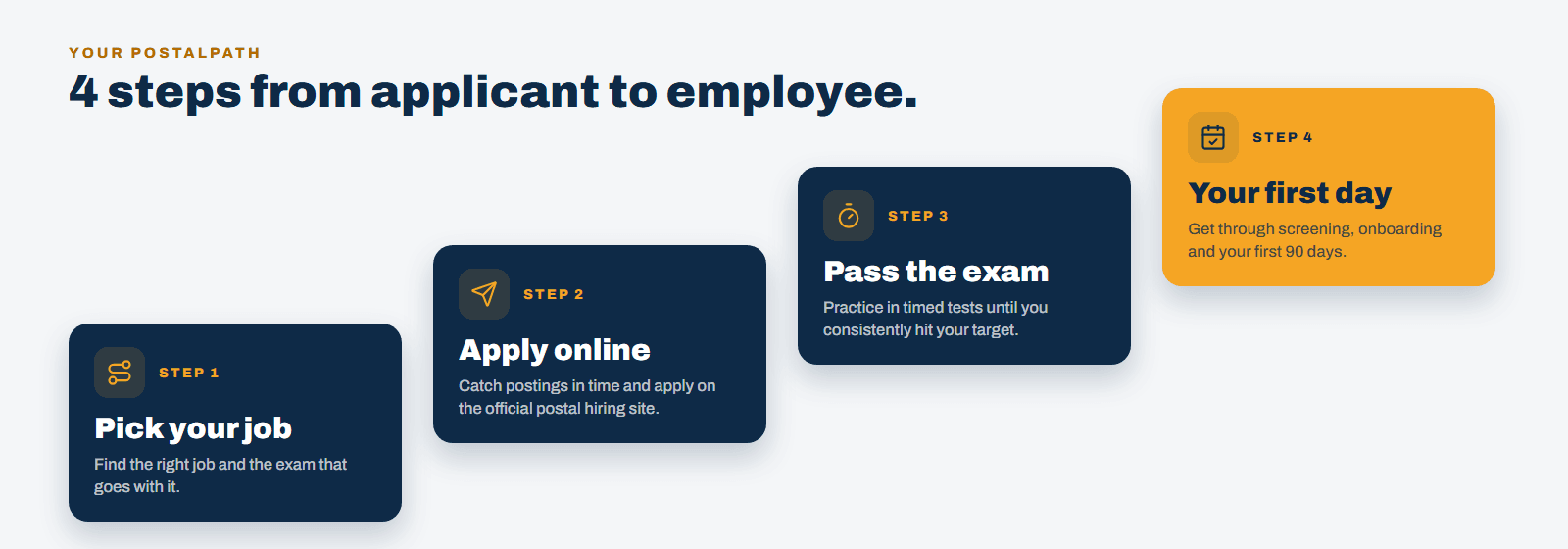
Many applicants are caught off guard by what the assessment asks.
Postal entry exams test how you think on the job: how you handle situations, how accurately you check details, and how you describe your own work history and style.

Use everything inside. Take your exam. If you don't feel it was worth it — pass or not — email us within 60 days and we'll refund every penny. No questions, no proof required.

Postal Exam 474 (Mail Carrier): what's on it, the rules, and free practice
Exam 474 is the Virtual Entry Assessment for carrier jobs: City Carrier Assistant, Rural Carrier Associate and Assistant Rural Carrier. It's an online, unproctored assessment you take on your own device, and for most carrier jobs it's the only thing standing between your application and a job offer, because most entry-level carrier postings no longer interview.
This page covers how the assessment starts, the rules that trip people up (the 72-hour window and the one-year retest rule), what each section asks, how your score is used, and three free sample questions in the Work Situations style.
PostalPath is an independent company and is not affiliated with, endorsed by, or connected to the United States Postal Service. Applying for USPS jobs is free at usps.com. Applying and taking the assessment are free; the posting or your invitation names the exact assessment, and PostalPath’s guidance is a starting point, not an official determination.
Who takes Exam 474
- City Carrier Assistant (CCA)
- Rural Carrier Associate (RCA)
- Assistant Rural Carrier (ARC)
How the assessment starts
- You apply for a carrier job on the official postal careers site.
- Depending on the job, you either start the assessment as part of your application or get an email invitation from the official testing vendor.
- You take it online, on your own device, wherever you like. Nobody watches you take it.
- Not everyone who applies is invited, and postings we reviewed said testing continues until capacity is reached. Apply the day a posting opens.
The rules at a glance
| Time to finish | 72 hours from when the invitation is sent (not when you open it) |
|---|---|
| Several applications | Same exam? Finish within 72 hours of the first invitation; one completed assessment counts for all of them |
| How long it takes | About 30 to 45 minutes |
| Devices | Computer, laptop, tablet or smartphone, online, on your own, unproctored |
| Breaks | One sitting is recommended, but you can split it up |
| Passing score | 70. Many postings rank by score, so higher is better |
| If you don't pass | No retake of Exam 474 for one year (12 months) from your latest attempt |
| Your result | Reused for later Exam 474 postings until the expiration date on your results (described as two years) |
| Miss the 72 hours | You're out for that job, but you can apply to others |
| Cost | Free. The postal service never charges for applications or exams |
The sections on Exam 474
| Section | What you do | Scored? |
|---|---|---|
| Realistic Job Preview | Watch or read about the carrier job | No |
| Work Situations | Pick the most and least likely action in a job situation | Yes |
| Tell Us Your Story | Answer questions about your work history | Yes |
| Describe Your Work Style | Choose which of two statements is more like you | Yes |
The postal service lists six section types for these exams and says not every version has every section. The table is based on a 2024 Inspector General report; that report didn't show a Checking for Accuracy section on Exam 474, and the current candidate guide also lists a What Motivates You section. Your version may differ, so be ready for every type. Older materials use older names: "Work Scenarios" and "Describe Your Approach".
How your score is used
- 70 passes. Passing doesn't guarantee a job.
- Higher is better. Postings refer applicants in one of two ways: everyone above an assessment cut-off score, or "a set number of the highest-ranked eligible candidates". Either way, a higher score can help. Eligible veterans get preference points added.
- Your score follows you. Your result is reused automatically for later postings that use Exam 474 until it expires. The postal service's Inspector General has described these results as valid for two years.
- Only your first application to a posting counts. Applying twice to the same posting doesn't help.
- Weights aren't published. Nobody outside the postal service knows how much each section counts. Treat every scored section as if it matters.
- The score carries weight. A 2024 Inspector General report said interviews stopped for most entry-level (pre-career) jobs when hiring was centralized in 2019. For most carrier jobs, there's no interview to make up ground.
Work Situations: three free practice items
You read a job situation and four possible responses, then choose the one you would be most likely to do and the one you would be least likely to do. These are PostalPath originals, written to build the same skills; they are not real or official questions. Our recommended answers are based on what postal employers value: safety, procedure, customer service, supervisor communication, accountability, teamwork and protecting the mail.
1. A customer asks questions about shipping choices, but you do not know the answers. Which would you be most and least likely to do?
- A. Apologize and explain that, as a mail carrier, knowing about shipping choices is not part of your job.
- B. Say you will have answers tomorrow and research the shipping choices after finishing your deliveries.
- C. Ask your supervisor for answers so you can give them to the customer tomorrow.
- D. Say you do not know about shipping choices and suggest that he look on the official website.
Our answer and reasoning
Most likely: C · Least likely: A. C gets the customer an accurate answer from someone who knows, while you stay on your route. D is honest and a reasonable runner-up, but hands the work back to the customer. B promises answers you'll research alone with no guarantee they're right. A, "not my job", closes the door: to the customer, you are the postal service.
2. A new employee is having trouble learning his job, which forces you and others to work harder to meet production standards. Which would you be most and least likely to do?
- A. Do nothing because his production should improve over time.
- B. Tell him to ask if he has questions about how to do his job.
- C. Tell him how to do his job quicker and better.
- D. Tell the Postmaster that the new hire is not working out and should be moved into a different type of job.
Our answer and reasoning
Most likely: B · Least likely: D. B opens the door to help without taking over or judging him; new hires improve faster when they know who they can ask. C can land as criticism from a peer who may not know how he was trained. A is passive. D decides a new hire "isn't working out": a management call, not yours, and premature.
3. A customer is angry because the nearby Post Office does not have a product he needs today. Which would you be most and least likely to do?
- A. Go get the product at another facility and bring it back to the customer.
- B. Tell the customer he should call the Postmaster to complain.
- C. Say you will tell him when that product becomes available.
- D. Suggest an alternate product that may work.
Our answer and reasoning
Most likely: D · Least likely: A. D solves today's need with what's available. C follows up but doesn't help him today. B passes his frustration along without helping. A looks like great service, but a carrier leaving the route to run an errand abandons the deliveries and the mail assigned to you: the classic "hero" trap.
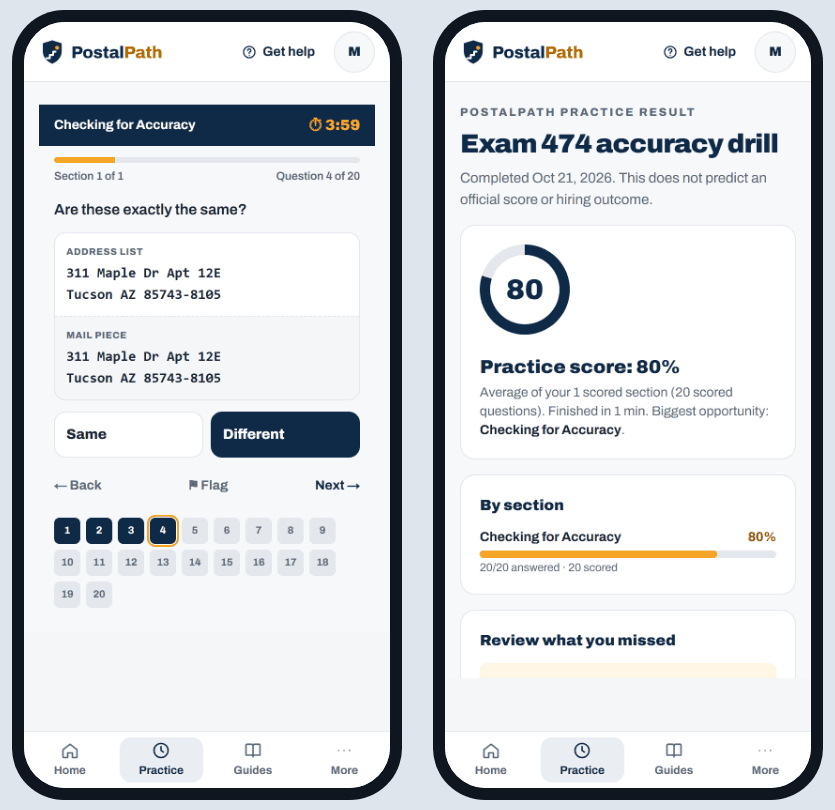
Try a timed practice section free
Seven sample questions in the real section styles, scored instantly, no account needed. Then PostalPath Complete adds full timed practice tests for every exam, 16 guides and application help.
Tips that actually matter
- Start within the first day of your 72-hour window, while you still have time to recover from a dead battery or a dropped connection.
- Use a computer or laptop if you can: the bigger screen helps on anything that asks you to compare details.
- Plug in, turn on Do Not Disturb, close other tabs, and don't start right before your computer wants to restart for an update.
- Don't skip through the Realistic Job Preview. It isn't scored, and it's your best look at whether the job fits your life.
- Answer the work-history and work-style sections honestly. Similar questions may appear more than once in different words, and honest answers tend to stay consistent on their own.
- Don't take it "just to see". A fail locks you out of this exam for a year; a low pass follows you until it expires.
Go deeper on each section
- Work Situations on the postal exam: what it asks and how to answer
- Tell Us Your Story: the work-history section of the postal exam
- Describe Your Work Style and What Motivates You: the paired-statement sections
- The 72-hour window and the one-year rule: the two postal exam deadlines that cost applicants a year
- Got your postal exam invitation email? What it is and what to do first
- Failed the postal exam? What the one-year rule really means, and what you can do now
- Exam 474 Work Situations practice: 6 carrier questions with answers explained
Exam 474 questions people ask
- What is postal Exam 474?
- Exam 474 is the Virtual Entry Assessment (VEA) for mail carrier jobs. It's taken online, on your own device, usually within 72 hours of an invitation, and takes about 30 to 45 minutes.
- What score do I need to pass Exam 474?
- 70 is passing. Passing doesn't guarantee a job: many postings rank applicants by score, so a higher score helps.
- What happens if I fail Exam 474?
- You can't retake Exam 474 for one year from your most recent attempt, and you won't be considered for jobs that use it during that time. You can apply to a job that uses a different exam right away.
- Do I have to pay to take Exam 474?
- No. Applying for a postal job and taking the assessment are always free. Anyone who charges to apply for you or to "get you the job" is not the postal service.
- Do I need to study for Exam 474?
- The postal service says you don't need to study. Practice is about familiarity with the format and building real skills (accuracy, judgment), not memorizing answers, and it matters because your first attempt is the one that counts for a year.
- Is there a Checking for Accuracy section on Exam 474?
- A 2024 Inspector General report showed the job preview, work situations, work-history and work-style sections on Exam 474, and no accuracy-checking section (475 and 476 had one). The postal service doesn't publish an exam-by-exam map, so your version may differ.
- Which jobs use Exam 474?
- City Carrier Assistant (CCA), City Carrier, Rural Carrier Associate (RCA) and Assistant Rural Carrier (ARC). The posting or your invitation names the exact assessment; our job-to-exam guidance is a starting point, not an official determination.
Reviewed October 2026 against the official exams and careers pages, the current candidate guide and Inspector General reports. PostalPath practice questions are original; they are not real, official or leaked questions.